Kingship and Biblical Irony III: Jerusalem and Tel Aviv

In the previous episode, we saw how God—through Moses—placed the emphasis on the values of the king rather than on the form of government, both in anticipation of establishing a monarchy in Israel (Deut. 17:14) and in outlining its ideal characteristics (Deut. 17:15–20). We will now examine the details of each verse more closely. Perhaps we will discover that the ideal portrait of Israel’s future king has much to teach us. Today, we will focus on the first verse of our passage:
Deut 17:14 (NIV) : When you enter the land the Lord your God is giving you and have taken possession of it and settled in it, and you say, “Let us set a king over us like all the nations around us...”
The establishment of a monarchy creates a tension between Israel’s distinctive national identity and its ability to relate to the wider world. Israel seeks simultaneously to implement God’s Law and to be "like all the nations." This tension is far more organic than one might imagine; it exists at the most fundamental human level: we are torn between the call to deepen our unique, mission-driven character and the need to integrate into a society and culture. One might suggest that this organic dynamic is mirrored in the Israeli national consciousness within the passage from Deuteronomy (among others). One might even wonder whether this concession to the logic of the Nations—choosing a king to be like the others—represents a concession by God to human nature, or perhaps even to its sub-human aspects.
Indeed, in the Bible, God tends to place a heavy burden of responsibility on humanity while lowering His expectations once failure has occurred. Examples abound, but consider the case of Cain and Abel: they were the firstborn on earth, charged with upholding an ethic rooted in the Paradise where their parents were conceived. Naturally, they failed; one became a victim, the other a criminal. Seth was born as a representative of ordinary humanity—a terribly fallible replacement [1], yet the only one capable of turning toward God [2]. What holds true for the individual applies equally to the State.
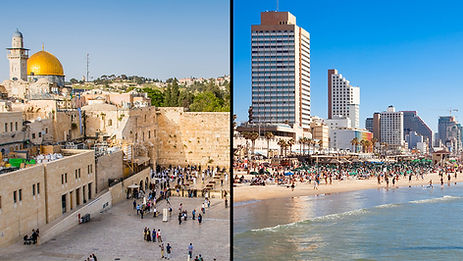
For decades, one of the most open internal conflicts in Israeli society has been the clash between two visions of the Nation of Israel. Broadly speaking, this is a conflict between Tel Aviv and Jerusalem: between those who wish for Israel to be a democratic state like any other among the community of (Western) nations, and those who wish for it to be a state structured by the Law of the Torah. One might well consider this conflict a credit to the Israeli project. For one vision to completely exclude the other would be inhumane; for the other to exclude the first would be uncommunicable. Accepting this tension as a process of giving birth is an affirmation of life. God Himself, in choosing life, accepts this concession.
Perhaps this is why he is giving a future monarchy a chance. Despite everything.
C. L.
[1] Since Cain left no descendants beyond the Flood, Seth replaces both Cain and Abel. See Gen 4:25b (NIV) : “God has granted me another child in place of Abel, since Cain killed him.”
[2] Gen 4, 26 (NIV) : "Seth also had a son, and he named him Enosh. At that time people began to call on the name of the Lord."
To be continued...


Comments